As the days of Noah | Session 27 | Genesis verse-by-verse study | Genesis 5:25-6:2
Where Are We
The last time we met, we walked through the genealogy of Adam and came all the way down to Enoch, the seventh from Adam. We saw that Genesis 5 is not merely a genealogy giving us history, but rather a testimony concerning:
- The death and vanity of our life,
- The promise of eternity and a restored relationship with God,
- The pursuit of righteousness,
- And the line which leads us to Christ.
We also saw the repeated words, “and he died,” which reminded us that apart from Christ, the life of man is nothing but vanity.
Enoch, the Man Who Walked with God
As we reviewed the chart, we came to Enoch, who walked with God, pleased God, and was taken by God because he pleased Him.
We understood his testimony through the New Testament, since Scripture speaks about Enoch’s walk with God, why he pleased God, and why God took him.
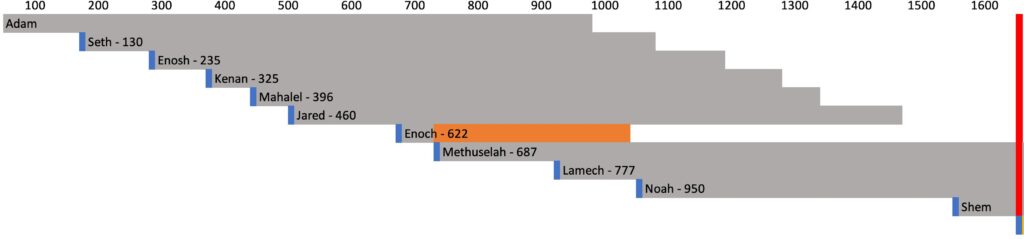
With that, we will review the genealogy chart one more time and continue into the rest of the genealogy, beginning from Genesis 5:25.
Methuselah, the son of Enoch | Genesis 5:25-27
Methuselah lived one hundred and eighty-seven years, and begot Lamech.
After he begot Lamech, Methuselah lived seven hundred and eighty-two years, and had sons and daughters
So all the days of Methuselah were nine hundred and sixty-nine years; and he died.
The Name — Methuselah
Enoch had a son when he was sixty-five years old, and he named him Methuselah. Scripture proclaims that Enoch then walked with God for another three hundred years before he was taken up by God.
Let us understand this name, Methuselah. Every name in Scripture carries meaning, but often, though we may know the meaning of a name, we do not fully understand what the good Lord is teaching us through it.
In this case, however, the name Methuselah gives us a clearer understanding within the context of our study. Methuselah was born 692 years after we began counting the years from the life of Adam.
Scholars translate the name in several different ways:
– Jones’ Dictionary of the Old Testament uses the traditional translation, “When he is dead, it shall be sent,”
– while other Old Testament dictionaries translate the name as “Man of Javelin” or “Man of Dart.”
Why are there multiple translations for the same word? Because the understanding is derived from the root of the word itself.
If we break down the name “Methuselah,” the first part of the word, either “mat” or “met,” can refer to “man” or “death,” while the second part, “shalah,” is a verb meaning “to send” or “to let go.” Thus, the combined meaning becomes: “When this man dies, it shall come,” or “When he is dead, it shall be sent.”
“When He Is Dead, It Shall Be Sent”
Interestingly, if we review the genealogy chart and calculate the years provided in this chapter, we find that the great flood came in the same year Methuselah died. Just as his name proclaimed, when he died, it was let loose. When Methuselah died, the flood came.
Methuselah was born 692 years after the years of Adam began to be counted. He fathered Lamech at the age of 187 and then lived another 782 years, reaching a total age of 969 years, making him the oldest man recorded in Scripture.
If we review the chart carefully, Adam was still alive during the early years of Methuselah’s life. Methuselah witnessed his father Enoch walking with the Lord and being taken by God. He would also live to see Noah building the ark.
Why would God allow Methuselah to live such a long life? We know that when he died, the flood would come. So what did God do? He gave Methuselah the longest lifespan among men.
Methuselah’s long life was not merely grace toward him, but grace toward a wicked, evil, and adulterous generation, giving them time to repent.
God’s Judgment and Mercy
The judgment of God is always associated with mercy. Peter reminds us in his epistle not to consider the long-suffering nature of God as slackness in fulfilling His promise. Rather, God waits patiently, desiring that none should perish, but that all should come to repentance.
If there is an example of the patience and long-suffering nature of God, the life of Methuselah stands as a powerful testimony.
2 Peter 3:9 — “The Lord is not slack concerning His promise, as some count slackness, but is longsuffering toward us, not willing that any should perish but that all should come to repentance.”
Yet we must also understand this: though God is long-suffering, and though His desire is that all may be saved, many still reject Him.
What is so powerful that it can resist the desire of God? We will see the answer later in Genesis 6. It is the evil heart of man. It is our heart that resists God’s desire to redeem us, restore us, and make us righteous.
What happened after Enoch that the end now needed to be ushered in?
The Beginning of the End
The last time we studied Enoch, we saw that he preached the coming judgment. Whenever Scripture speaks about coming judgment, the righteousness of Christ is proclaimed alongside it (John 5:30; John 7:24; 2 Timothy 4:8). This is not only because He is the Righteous Judge, but also because we will be judged according to His righteousness. We went through this in our study of 1 Corinthians 3.
Jesus Christ said that this gospel message must be proclaimed to the ends of the earth, and then the end will come. But the gospel message cannot truly be preached unless the righteousness of Christ is proclaimed.
Turn to Romans 1:16–17 to understand what this gospel message is.
Romans 1:16 — “For I am not ashamed of the gospel of Christ, for it is the power of God to salvation for everyone who believes, for the Jew first and also for the Greek.”
Romans 1:17 — “For in it the righteousness of God is revealed from faith to faith; as it is written, ‘The just shall live by faith.’”
If the gospel of Christ does not lead us to righteousness, then the fullness of the gospel is not being fully preached or fully understood. The message of the gospel should lead us toward righteousness, for the gospel of God reveals the righteousness of God.
With the beginning of the end now set in place through Enoch’s prophecy of coming judgment, and through the birth of Methuselah, which reveals the long-suffering nature and mercy of God, let us continue our reading. The genealogy will now culminate in the birth of Noah before Scripture moves into the narration of the flood.
Lamech, the son of Methuselah, the Father of Noah | Genesis 5:28-31
Lamech lived one hundred and eighty-two years, and had a son.
And he called his name Noah, saying, “This one will comfort us concerning our work and the toil of our hands, because of the ground which the Lord has cursed.”
After he begot Noah, Lamech lived five hundred and ninety-five years, and had sons and daughters.
So all the days of Lamech were seven hundred and seventy-seven years; and he died.
The Name Lamech
Let us first understand the name Lamech before we move further into the text. The name Lamech could mean “Strong Man,” “Powerful,” or “for humiliation.” The difficulty in pinpointing its exact meaning comes from the fact that the root word itself is not a standard Hebrew word.
The interpretations “Strong Man” and “Powerful” assume a Semitic root and derive the meaning from Arabic. However, if we break the word down further in Hebrew, “la” can mean “to” or “onto,” while “muk” can mean “to descend,” “to come down,” or “humiliation.”
Thus, the name can also carry the meaning of “coming down” or “coming down in humility.”
Lamech’s Years
Lamech fathered a son when he was 182 years old, and he named him Noah. After this, he lived another 595 years, bringing him into the same decade as the flood.
Though the chart may appear to show that he died in the year of the flood, Lamech actually died five years before the flood came. None of the patriarchs saw the flood except Noah and Shem.
Lamech was born in the year 874, assuming we are counting from the years of Adam, and he died in the year 1651, five years before the flood, at the age of 777 — an interesting number.
In summary, when we review the timeline of the final patriarchs before the flood:
– Enoch was taken away by God before the flood,
– Lamech died five years before the flood,
– Methuselah died in the year of the flood,
– Noah and his children were preserved through the flood.
Lamech’s Prophecy
There is something important we must notice about Lamech. In the genealogy of Adam, Lamech is the only patriarch whose words are recorded. None of the other patriarchs have their words preserved in the genealogy narrative.
The good Lord pauses the genealogy and ensures that these words are recorded, and therefore we should study them carefully. What Lamech proclaims here is prophetic.
Lamech declares that Noah will comfort them concerning the work of their hands because of the ground which the Lord had cursed.
The Lord indeed fulfilled this prophecy, but we must ask an important question: How did God bring this comfort? He brought comfort through the flood. But is that the comfort Lamech was speaking about?
Let us also notice a comparison that Scripture itself presents to us. There are two Lamechs recorded in the Bible. The first Lamech appears in the genealogy of Cain, and interestingly, he too is the only person in Cain’s genealogy whose words are recorded.
In Genesis 4:23–24, the Lamech from Cain’s line speaks of murder, vengeance, and violence. But this Lamech, the final patriarch in the genealogy of Seth before the arrival of Noah and the flood, speaks of comfort and rest. His son’s name is Noah.
The Name Noah
There is only one Noah in Scripture, and he is the son of Lamech. The name Noah means “Rest.”
Noah is mentioned not only in the flood narrative, but throughout both the Old and New Testaments. In the New Testament, Noah is listed among the heroes of faith in Hebrews 11:7, and he is called a “preacher of righteousness” in 2 Peter 2:5.
But before we move into the life of Noah, let us first understand the prophecy and the words proclaimed by Lamech at Noah’s birth.
The Prophecy of Lamech | Genesis 5:28-31
Genesis 5:29 – And he called his name Noah, saying, “This one will comfort us concerning our work and the toil of our hands, because of the ground which the Lord has cursed.”
The Cursed Ground
According to Lamech, Noah would bring comfort concerning the toil and labor of mankind because of the ground which the Lord had cursed.
Lamech is pointing us back to the original curse pronounced in Genesis 3:16–17.
Remember that the Lord’s curse is a judgment that has been declared, and it is irrevocable. If you recall our earlier study in Genesis 3, the Lord God pronounced two specific curses: one upon the great dragon, the serpent, and the other upon the ground.
In a sense, neither Adam nor Eve themselves were cursed. In this context, Lamech is pointing specifically to the curse placed upon the ground.
What was that curse? Let us read Genesis 3:17 once more, because we will notice that Lamech uses the same language.
Genesis 3:17 — “Then to Adam He said, ‘Because you have heeded the voice of your wife, and have eaten from the tree of which I commanded you, saying, “You shall not eat of it”: “Cursed is the ground for your sake; in toil you shall eat of it all the days of your life.”
The curse pronounced by the Lord was that the ground would now require labor and toil for man to live upon the earth.
In many ways, this has become the very pattern of our earthly life. We study in order to work upon this earth. We work in order to continue living upon this earth. For many people, this becomes the entirety of life itself. Rather than doing what the Lord originally commanded — to tend and keep the earth — we now labor out of the earth in toil.
And upon this earth, where Lamech and all mankind labor and struggle, Noah was expected to bring comfort and rest.
In Toil
The word “toil” here is the same word the Lord used in Genesis 3:16–17. It refers to the labor pain a woman experiences before childbirth. This same pain and toil is now applied to the labor of man under the curse of the ground.
Lamech is saying that mankind is going through labor pains, expecting something — or rather, expecting Someone.
Understand this carefully: the cursed ground proclaimed in Genesis 3:16–17 cannot ultimately be redeemed. It must one day be destroyed, for the Lord has promised a new heaven and a new earth.
The only way for Lamech and the people of that generation to escape this curse is through the coming of the Messiah. This is the comfort to which Lamech is pointing.
Lamech is not longing for earthly abundance or prosperity. He is longing for the restoration of the earth and the restoration of mankind unto God.
The testimony of Adam, Enoch, and all the patriarchs is that they labored and toiled upon this earth while waiting for the coming kingdom.
Let us now understand this through the New Testament, because in our natural understanding, comfort is not typically associated with destruction.
The Comfort — In the New Testament
In Matthew 5, the good Lord proclaimed, “Blessed are those who mourn, for they shall be comforted.”
This is what Lamech is doing. He is mourning, because he understands that the only true redemption is God Himself.
What is the comfort the Lord promises in Matthew 5:4? Turn to 1 Thessalonians 4:13–18. It is a long passage, so we will summarize it.
This is the comfort required for the believer — not merely that we will continue to live and never die, but that we will be with the Lord always. That is the true comfort.
Remember the study we have been pursuing for weeks now: the greatest desire of the men of God was that they would be with the Lord.
That alone could bring them comfort.
This is what Adam longed for. This is what Abel desired, according to Hebrews 11. This is what Enoch desired, and he was taken up to be with the Lord. This is what Lamech is longing for, and this is what Noah himself will desire.
This is the comfort Noah would ultimately bring, for through the lineage of Noah, the good Lord would extend His mercy and preserve a future for mankind in Him.
Sign of the Times
We now move into the next section of Scripture, which speaks about Noah and the generation in which he lived. This is a very important portion of our study because it is the very passage the Lord pointed us to in the New Testament.
But before we continue, let us summarize what we have learned so far.
From Adam to Lamech, nine generations are recorded in Scripture. Yet Adam and Eve had many other children beyond Cain and Abel. Even using very restrained estimates, the population during the days of Noah could easily have exceeded the population of the world today. Even with extremely conservative calculations, it could still have reached well over a billion people.
The ground was cursed. The knowledge of God was fading. At the same time, culture and technology flourished. These men were highly intelligent in worldly wisdom, powerful, resourceful, and capable of remarkable achievements, as we will later see again in Genesis 11.
Yet if there is one characteristic that defines this generation, it is the testimony of Genesis 6 — that every thought of mankind was evil continually.
It is during this time that Lamech cries out for comfort and calls upon the Lord. They had not forgotten the promise of God.
But righteousness was not spreading — sin was spreading. It was not Abel who increased in strength and influence, but Cain. The path of righteousness has always been a narrow road.
With that, let us continue our study with Noah.
Noah and His Sons | Genesis 5:32
Genesis 5:32 — “And Noah was five hundred years old, and Noah begot Shem, Ham, and Japheth.”
This generation would now be preserved through the flood, along with their wives. We do not know which family line Noah’s wife, or the wives of Shem, Ham, and Japheth, came from.
Noah and Shem from the Timeline
One thing I want to call out is the genealogy of this generation. Scripture tracks the genealogy of Shem because he is in the lineage of Christ.
When we look at the pre-flood genealogy, the orange bar represents the time Noah was building the ark according to Scripture. From the timeline, we can see that Shem was born after the construction of the ark had already begun.
But what we often miss is what happens after the flood. We have to understand that Noah, Shem, Ham, and Japheth had seen the sin of mankind in its fullness. The Lord Himself said that He would come when the days are like the days of Noah.
They also knew why they had been preserved. We will study this later, but Scripture tells us that Noah found grace in the eyes of the Lord.
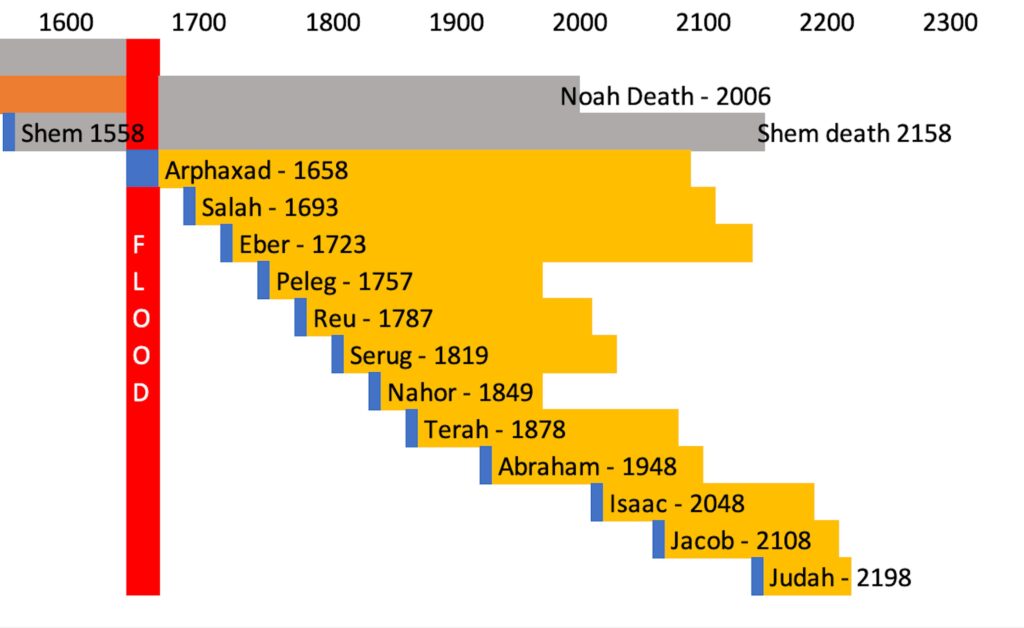
After the flood, both Noah and Shem lived many more years. From the timeline, we can see that Noah lived to see the birth of Abraham, and Shem lived to see the births of Isaac and Jacob.
Though they had not yet seen the fulfillment of the promise, while they were still alive, God had already chosen Abraham, who would carry the promise of the Seed, the promise of the Redeemer, who would one day bring comfort to our souls.
Noah lived a total of 950 years — 600 years before the flood and 350 years after the flood (Genesis 9:29).
Shem lived 600 years — 98 years before the flood and 502 years after the flood (Genesis 11:10–11). Shem lived longer after the flood than before the flood.
The years of men decreased drastically after the flood, yet God preserved Noah and Shem for many years.
Shem, Noah, their wives, Ham, and Japheth were the only witnesses who carried testimony from the old world into the new world — the testimony of God’s love, His righteousness, the promise of eternal life, and the coming Messiah.
As the Days of Noah | Genesis 6:1–2
Genesis 6:1 — “Now it came to pass, when men began to multiply on the face of the earth, and daughters were born to them,”
Genesis 6:2 — “that the sons of God saw the daughters of men, that they were beautiful; and they took wives for themselves of all whom they chose.”
The Sons of God
Genesis 6 is one of the most controversial and heavily debated passages in Scripture. The central issue revolves around the phrase “sons of God.” Who are these sons of God who married the daughters of men?
There are two major interpretations of this passage. First, we will look at what the church historically taught, and then we will wrestle with the text itself through Scripture and through the grace of the Holy Spirit.
The Teaching of the Church
The two primary interpretations are:
– that the “sons of God” are fallen angels,
– or that the “sons of God” refer to the line of Seth, the chosen line, intermarrying with the daughters of Cain.
What did the church teach through history?
Interestingly, the early church fathers, from the earliest centuries up to the fourth and even early fifth century, largely taught that the “sons of God” referred to fallen angels. There was very little challenge to this interpretation during that period.
However, as the holy catholic church became more established, the interpretation gradually shifted toward the understanding that the “sons of God” were the descendants of Seth marrying the descendants of Cain.
This understanding continued into the Reformation period. Teachers such as Martin Luther and John Calvin rejected the fallen angel interpretation and instead taught that the “sons of God” referred to the children of Seth.
During the nineteenth century, however, theologians began revisiting the writings of early Christendom and the early church fathers, and the fallen angel interpretation again resurfaced in some circles.
Today, most orthodox churches continue to hold the Sethite interpretation, while some charismatic and evangelical groups lean toward the fallen angel understanding.
Yet as we study the text, we must still wrestle carefully with what it means when Scripture speaks about the “sons of God” and the “daughters of men.”
The Sons of God
The phrase “sons of God” in Hebrew is Ben Elohim. This phrase appears several times in Scripture — in Genesis 6:4, Job 1:6, Job 2:1, and Job 38:7.
If we temporarily set Genesis 6:4 aside, the remaining references clearly refer to angels.
For example, Job 38:7 declares that the sons of God were present when the foundations of the earth were laid. Therefore, they cannot be referring to humans, since this occurred before the creation of mankind.
If we simply follow the usage of Scripture in its immediate context, the most straightforward reading would point toward angels. This is one reason why the early church did not initially question that interpretation.
Why then did the church beginning in the fourth and fifth centuries move away from this understanding? And why do many today continue to reject it?
The reasons are generally twofold.
Reason One
First, if the angelic interpretation is accepted, some believe it risks shifting the responsibility for sin and corruption away from mankind and placing it primarily upon fallen angels.
Yet Scripture is clear that the corruption of the world was not merely because of fallen angels, but because of the evil heart of man — as Genesis 6:5 later declares.
The church feared that focusing too heavily upon a supernatural explanation could weaken the call to repentance by redirecting blame away from mankind itself.
Reason Two
The second major reason came from a New Testament passage where Jesus Christ taught that angels are not given in marriage.
Theologians such as Augustine, around the fourth century, used this passage to argue against the fallen angel interpretation.
As Angels
Let us now look at this second reason more carefully by turning to Matthew 22.
Matthew 22:29 — “Jesus answered and said to them, ‘You are mistaken, not knowing the Scriptures nor the power of God.’”
Matthew 22:30 — “For in the resurrection they neither marry nor are given in marriage, but are like the angels of God in heaven.”
The context here concerns resurrection and procreation. The Sadducees asked the Lord about a woman who had married seven brothers successively because each brother died without children. According to their tradition, the next brother would marry the widow so that the family line would continue and the name of the deceased would not disappear.
The Sadducees then asked: whose wife would she be in the resurrection?
The Lord answered that there is no marriage in heaven because there is no death in heaven. Marriage and procreation are no longer necessary in the resurrection state.
The Lord specifically refers to “the angels of God in heaven.” These are angels who remain in their heavenly estate, not angels who have fallen from it.
But this still leaves us with an important question regarding the first issue about sin and redemption:
What was the true reason for the corruption of this generation? Was it because of fallen angels?
From the New Testament
In the Gospel of Matthew, the disciples came to the Lord and asked Him, “Lord, when will the end come? When will You come to establish Your Kingdom?”
This leads us into Matthew 24, one of the most studied prophetic passages in Scripture. In this chapter, the Lord teaches concerning many signs that point toward the end. Yet ultimately, He brings our attention to one central comparison, which we read both in Matthew 24:36 onward and in Luke 17.
Let us turn to Luke 17, where the Lord gives us two examples.
Luke 17:26–29 —
“And as it was in the days of Noah, so it will be also in the days of the Son of Man:
They ate, they drank, they married wives, they were given in marriage, until the day that Noah entered the ark, and the flood came and destroyed them all.
Likewise as it was also in the days of Lot: They ate, they drank, they bought, they sold, they planted, they built;
but on the day that Lot went out of Sodom it rained fire and brimstone from heaven and destroyed them all.”
The people in the days of Noah and Lot were not concerned about the things of the Lord. They were consumed with the things of the world.
Especially in the days of Noah, we must understand that the people still possessed knowledge of God. They had one language, and the earth had not yet been divided by oceans. Yet they were not concerned with righteousness. They were not concerned with the plan of God, which is that we might be with Him. Instead, they pursued the things of the world.
They knew about God, but they did not seek Him in order to be with Him. They did not pursue righteousness.
And perhaps we are living in similar days now — days in which the knowledge of God still exists, yet few pursue Christ for His righteousness. Instead, many pursue the Lord merely so they may be blessed in this present world.
That was the condition of the world before the flood. They ate, they drank, they worked hard, they took vacations, they married, had children, built houses, established governments, and lived as though this world would continue forever — not realizing that life without Christ is vanity.
Let us continue further in Luke 17.
Luke 17:32–33 —
“Remember Lot’s wife.
Whoever seeks to save his life will lose it, and whoever loses his life will preserve it.”
This is the difference.
It is not merely those who attend church who will preserve life, but those who truly know Christ. It is not simply belonging to a church family that preserves life, but laying down one’s life before the Lord.
To deny ourselves is to place Christ above all things and to pursue Him with all that we are.
What is your greatest desire today? Is it to know Christ, to be with Him, and to spend time with Him? Or is Christ only someone we approach in order to obtain the things we desire in this world?
Only those who lose their lives for His sake will preserve them.
If our pursuit of Christ is only so that we may prosper in this world, then we are no different from the generation of Noah. We become the very people who miss the ark when the door is finally shut. And by the time the door closes, it will already be too late.
Today, the Lord reminds us that only those who truly seek Him will be preserved — those who lose their lives so that they may gain them in Him.
So now, returning to the question of the “sons of God,” whether one holds to the fallen angel interpretation or the Sethite interpretation, the greater issue remains the same:
Unless our pursuit in life is Christ and Christ alone, we fall into the very same corruption that marked the pre-flood world.
The Sons of God
The fallen angels may have been an extension of mankind’s corruption, but they were not the ultimate cause.
Both in the Old Testament and in the New Testament, when the Lord spoke about the days of Noah, He did not place the emphasis upon fallen angels. Instead, He pointed to the condition of the human heart — mankind’s failure to pursue God, failure to understand why we were created, and failure to understand the work of the Lord.
Even in the book of Revelation, it is not merely the work of the devil that keeps people from coming to Christ. Rather, it is the hardness of the human heart. Though mankind will know that there is one God and that Jesus Christ is the Lamb of God, many will still reject Him and instead place their trust in the devil and the blasphemer so they may continue living according to the desires of this world.
The Corruption of Our Heart
So let us ask this question: does it really matter to know who the “sons of God” are?
Yes, it does matter. Not only for understanding Genesis 6:2, but because understanding the pre-flood world is important in light of what the Lord Himself taught us in the Gospels.
The true reason for corruption was the evil heart of man.
Look again at the timeline. How many people were saved? How many truly pursued God so that they might be with Him?
Only one man is specifically said to have found grace — Noah.
Now look at the world after the flood. Even while Noah and Shem were still alive, the earth again became corrupt, as we later see in the account of Sodom and Gomorrah.
What excuse remained then?
Even there, we again read about angels, and about men desiring sinful union with them.
Yet God did not destroy Sodom and Gomorrah merely because of angels. The destruction came because of the evil heart of man.
How Do We Deny Ourselves?
What then should we do? How do we truly deny ourselves?
If we attempt to deny ourselves merely through human effort, by fighting against the flesh in our own strength, we will ultimately fail. The flesh cannot overcome the flesh.
Scripture instead teaches us a different path. In 2 Peter 1:5–10, we are shown that denying ourselves is not primarily accomplished by focusing upon resisting sin, but by pursuing Christ with all that we have.
As we pursue Him, something begins to happen within us. Christ abides in us, and we abide in Him. The Holy Spirit begins transforming our desires, our thoughts, and our affections.
That is why Scripture says that when these things abound in us, we will neither be barren nor unfruitful in the knowledge of our Lord Jesus Christ (2 Peter 1:8).
The Lord is teaching us that the Christian life is ultimately a pursuit of Christ and a continual growth in the knowledge of Him.
2 Peter 1:5–7 teaches us:
“…giving all diligence, add to your faith virtue, to virtue knowledge, to knowledge self-control, to self-control perseverance, to perseverance godliness, to godliness brotherly kindness, and to brotherly kindness love.”
Notice that this is not merely external behavior modification. This is the work of the Holy Spirit producing the character of Christ within us.
As we pursue Christ, He transforms us. As we abide in Him, we grow in His grace. And as we grow in Him, we slowly begin to deny ourselves — not because we are strong, but because Christ is being formed within us.
That is the only way we can truly deny ourselves.
Closing Thoughts
As we close this study, we must remember what marked the days of Noah. The corruption of that generation was not merely outward wickedness, but a heart that no longer pursued God.
They knew about God, yet they did not seek Him. They lived as though life upon this earth was all that mattered.
But amidst that generation, Noah found grace in the eyes of the Lord.
The call of Scripture remains the same even today. The Lord is not looking merely for people who acknowledge Him, but for those who pursue Him, desire His righteousness, and long to be with Him.
The days of Noah remind us that the path of righteousness has always been narrow. Yet they also remind us of the mercy, patience, and long-suffering nature of God, who still calls men unto Himself.
May our pursuit not be the things of this world, but Christ Himself.
For only those who seek Him will find true rest, true comfort, and eternal life in Him.
In Christ — Noel Kingsley
All content © 2026 Noel Kingsley, www.Jeremiah364.com.
These studies are freely shared for personal growth, family devotion, and group Bible study. You are welcome to reproduce them in full, provided no changes are made and proper credit is given. Please do not use the material for commercial purposes.
Open the Scriptures to see Christ.
Study the Scriptures to know Christ.
Cling to the promises to grow in Christ.